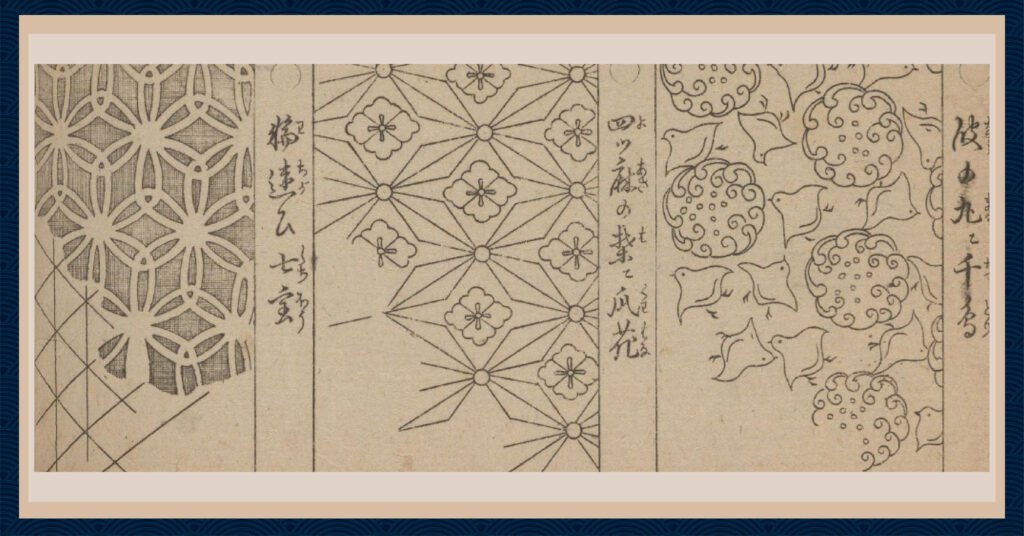
When contemporary audiences hear “arabesque pattern” in Japan, many might picture the green cloth with white vine designs often worn by cartoon thieves. However, Japanese arabesque patterns—known as “karakusa-moyo” in Japanese—represent a sophisticated design tradition with roots stretching back to ancient times. These ornamental motifs, which stylize the natural curves and growth patterns of vines and foliage, constitute a cornerstone of traditional Japanese decorative arts. Today, we’re excited to announce the free digital release of “Karakusa Moyo Hinagata,” a remarkable Meiji-era design manual showcasing 330 distinct Japanese arabesque patterns.
Understanding Japanese Arabesque Patterns: Origins and Evolution
Japanese arabesque patterns, despite their name, don’t originate from a specific plant called “karakusa” (literally “Chinese grass”). Rather, the term encompasses a wide variety of stylized plant-based decorative motifs. Similar design concepts exist worldwide under different names: “foliage scrollwork” in English, “Laubwerk” in German, “rinceaux” in French, and “mancaowen” (蔓草文) in Chinese—all referring to ornamental designs based on curving vines and foliage.
These Japanese arabesque patterns first arrived in Japan during the Nara period (710-794 CE) through cultural exchange with Tang Dynasty China. Initially, Japanese artisans faithfully reproduced Chinese designs, but during the Heian (794-1185) through Kamakura (1185-1333) periods, these motifs gradually evolved into distinctly Japanese styles. By the medieval era, Japanese arabesque patterns began featuring plants familiar to Japanese life—paulownia, wisteria, pine, bamboo, and plum—and were incorporated into court costumes and formal attire as “yusoku” patterns (aristocratic design conventions).
For Western readers unfamiliar with Japanese design history, this evolution parallels how European Gothic architectural ornament gradually developed regional variations while maintaining its fundamental vocabulary of natural forms. What makes Japanese arabesque patterns distinctive is their extraordinary balance between naturalistic representation and geometric abstraction.
During the Edo period (1603-1868), these Japanese arabesque patterns flourished across various crafts including textiles, weaving, and maki-e lacquerware. They even appeared on “meibutsu-gire” (famous textiles) used in tea ceremony contexts, such as gold brocade with arabesque designs. The enduring appeal of these patterns lies partly in their auspicious symbolism—the vigorous growth of vines represents vitality, prosperity, and continuity. The flowing, rhythmic qualities of Japanese arabesque patterns offer both visual serenity and dynamic energy to viewers.
“Karakusa Moyo Hinagata”: A Meiji-Era Encyclopedia of Ornamental Beauty
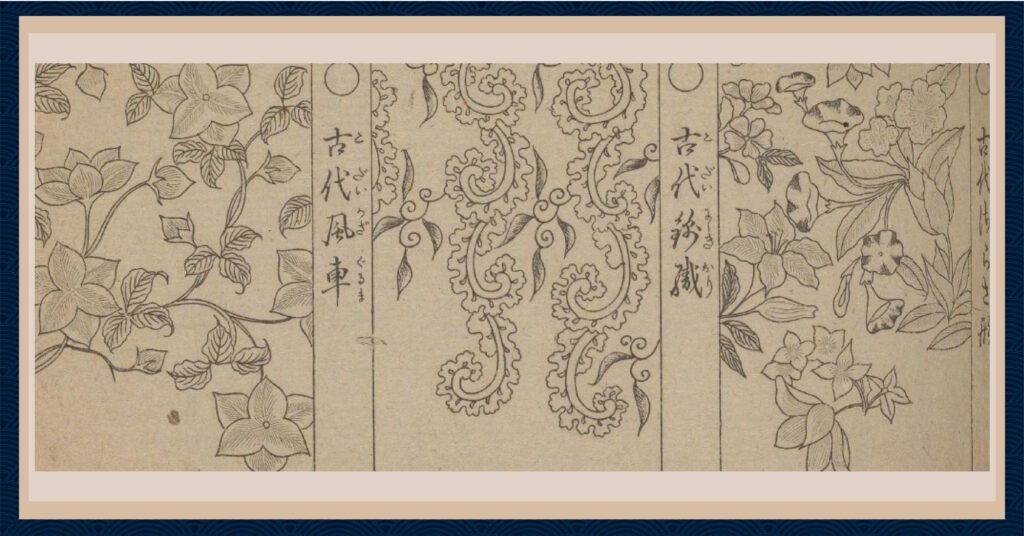
Published in 1884 (Meiji 17) by Takizawa Kiyoshi, “Karakusa Moyo Hinagata” stands as a comprehensive catalogue of Japanese arabesque patterns. This remarkable 128-page design manual presents three distinct patterns per page, culminating in an impressive collection of 330 different Japanese arabesque patterns.
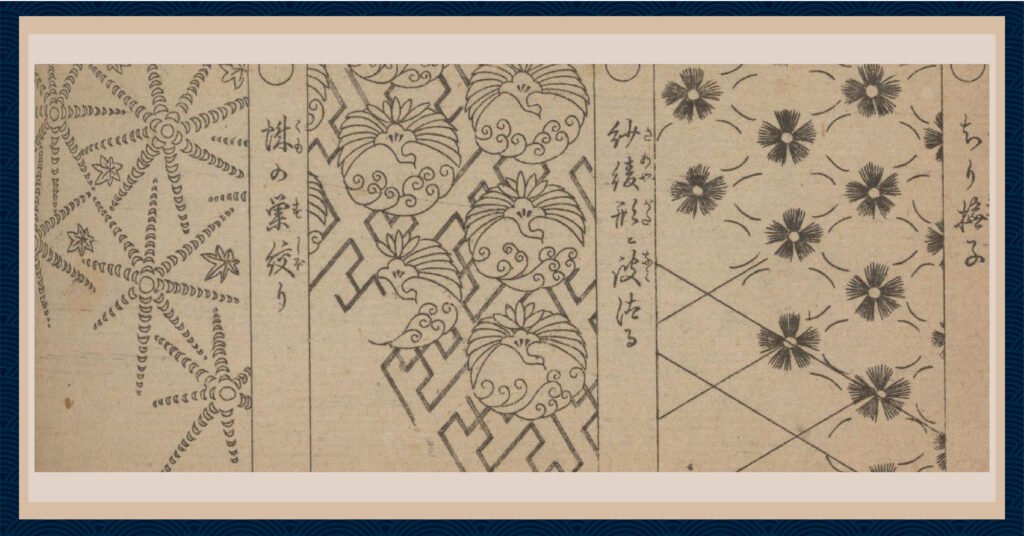
What makes this resource particularly valuable is its systematic presentation of traditional Japanese motifs. The collection includes designs instantly recognizable to modern eyes—like “asa-no-ha” (hemp leaf), “kikka-bishi” (chrysanthemum-diamond), and “shippō” (seven treasures)—alongside patterns that might not immediately suggest plant origins, such as “seigaiha” (blue ocean waves) and “chidori” (plovers).
Interestingly, these geometric patterns are also classified within the broader umbrella of Japanese arabesque patterns. For instance, while “seigaiha” ostensibly represents undulating ocean surfaces, its recurring arcs can be interpreted as abstracted overlapping water plants. Similarly, “chidori” patterns merge bird forms with leaf-like shapes, demonstrating how Japanese design often blurs the boundaries between different natural elements. This exemplifies a fundamental characteristic of traditional Japanese patterns—their tendency to transform natural forms into highly stylized, geometric designs while maintaining an essential connection to their organic inspiration.
The Allure of Japanese Arabesque Patterns: Bridging Tradition and Innovation
The remarkable aspect of Japanese arabesque patterns lies in their universality and diversity. Looking across world cultures, vine-like ornamental patterns derived from plant forms appear in ancient Egyptian, Greek, and Roman art, as well as throughout Islamic, Indian, and Chinese decorative traditions. This underscores how plant motifs serve as a common design language across human civilizations.
What distinguishes Japanese arabesque patterns is their perfect equilibrium between naturalistic representation and geometric abstraction. For example, the “asa-no-ha” (hemp leaf) pattern uses hexagonal geometry to evoke overlapping leaves. The “kikka-karakusa” (chrysanthemum arabesque) stylizes chrysanthemum blossoms while incorporating undulating vines to convey plant vitality. This harmonious balance between the concrete and abstract, static and dynamic, epitomizes the Japanese aesthetic sensibility.
Furthermore, Japanese arabesque patterns demonstrate remarkable versatility through combination. Traditional patterns like “asa-no-ha with shippō” or “kiku with seigaiha” (chrysanthemum with ocean waves) showcase how Japanese craftspeople maintained tradition while continuously seeking fresh expressions. This creative approach—respecting established design vocabulary while introducing subtle innovations—remains relevant to contemporary design practice.
In today’s design world, the rhythmic continuity, organic curves, and seamless fusion of natural and geometric elements found in Japanese arabesque patterns offer universal principles applicable across graphic design, textiles, and architectural decoration. These qualities transcend their historical context, making these patterns perpetually relevant design resources.
Japanese Arabesque Patterns in the Digital Age: Traditional Motifs for Contemporary Creators
The enduring charm of Japanese arabesque patterns remains undiminished by time. In fact, digital technology has expanded opportunities for reinterpreting these traditional motifs in contemporary contexts, opening new possibilities for creative expression.
The digitization and free distribution of historical resources like “Karakusa Moyo Hinagata” represents a landmark development, making traditional Japanese arabesque patterns accessible to designers and creators worldwide. In our globalized era, the significance of sharing region-specific design vocabularies as universal creative resources cannot be overstated.
Japanese arabesque patterns carry cultural meaning beyond mere decoration. Their continuous, flowing lines symbolize “continuity of life,” “prosperity,” and “growth”—embodying the Japanese worldview and aesthetic sensibilities. Understanding these cultural dimensions allows contemporary designers to incorporate Japanese arabesque patterns with greater depth and authenticity, moving beyond superficial “Japanese-style” appropriation toward meaningful cultural engagement.
Practical Applications of “Karakusa Moyo Hinagata”: A Gift to Designers and Illustrators
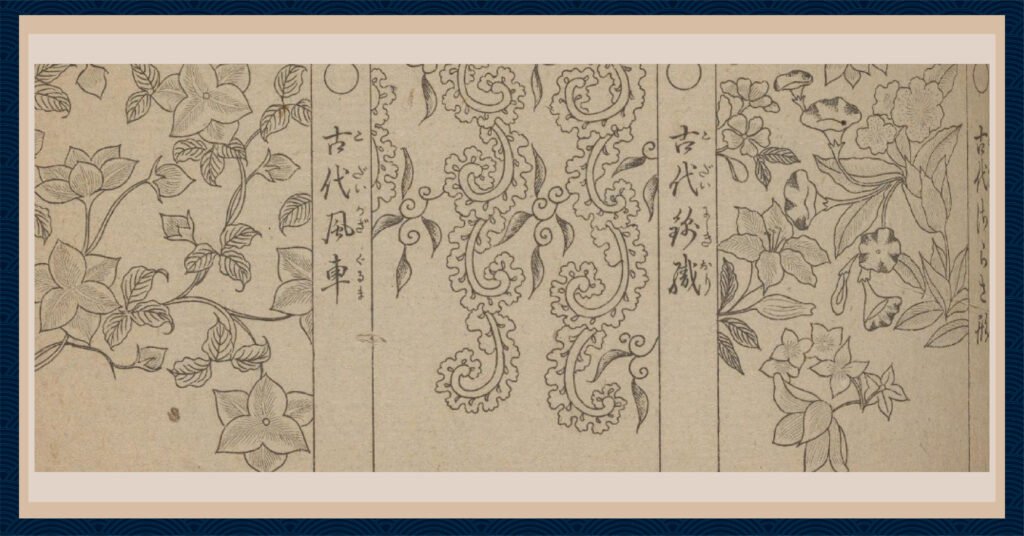
The 330 Japanese arabesque patterns contained in “Karakusa Moyo Hinagata” offer invaluable reference material for contemporary designers and illustrators. These patterns can be utilized in numerous ways:
- As decorative elements in graphic design, Japanese arabesque patterns can enhance logos, packaging, and posters, adding elegant Japanese atmosphere to borders and empty spaces.
- As textile design patterns, these motifs adapt beautifully to fashion fabrics, interior textiles, and craft materials.
- As web design background elements, Japanese-themed websites can incorporate these patterns as backgrounds, divider lines, or icons.
- As pattern elements for character design, Manga and anime character costumes and accessories can feature these traditional patterns for authentic Japanese styling.
- As reference for traditional crafts, Ceramics, lacquerware, textiles, and woodworking can all draw inspiration from these historical pattern designs.
With such diverse applications, “Karakusa Moyo Hinagata” truly represents a treasure trove for creatives seeking to incorporate authentic Japanese aesthetic elements into contemporary work.
How to Access “Karakusa Moyo Hinagata”: Free Download from Digital Archives
“Karakusa Moyo Hinagata” is now available through the Internet Archive, free for anyone to download. The process is straightforward: simply visit the URL below and select your preferred format (PDF, EPUB, Kindle, etc.) from the “DOWNLOAD OPTIONS” menu.
The high-resolution scans provide quality suitable for both printing and digital manipulation. The Internet Archive also offers numerous other traditional Japanese pattern books, including the previously mentioned “Hamon-shu” (wave pattern collection), making it an excellent resource for exploring Japanese design heritage.
Conclusion: The Significance of Digital Archives in Preserving Design Heritage
The digitization and free distribution of “Karakusa Moyo Hinagata” represents a profoundly meaningful contribution to preserving and sharing Japan’s visual cultural heritage. That this rare design manual from the Meiji era can transcend nearly 140 years to inspire contemporary creators underscores the timelessness and continuing relevance of traditional design vocabularies.
Japanese arabesque patterns embody the beautiful synthesis of natural vitality and human creativity. Their flowing continuity symbolizes the transmission of culture from past to present and into the future. Through the digital revival of “Karakusa Moyo Hinagata,” traditional Japanese design language gains new creative breath in our contemporary world.
We encourage you to download “Karakusa Moyo Hinagata” and explore its 330 diverse Japanese arabesque patterns. Within these designs lives something beyond mere decorative patterns—fundamental principles of beauty deeply rooted in Japanese cultural consciousness that continue to resonate across time and cultural boundaries.
For designers seeking authentic Japanese motifs, researchers studying historical pattern development, or anyone appreciating the beauty of traditional design, this free resource opens a window into a sophisticated decorative tradition that has influenced global design for centuries. Through digital preservation, these Japanese arabesque patterns—once accessible only to specialized scholars and collections—now become part of our shared creative heritage, ensuring these elegant motifs continue to inspire new generations of designers worldwide.
Explore More Free Downloadable Resources
If you’re interested in discovering more freely downloadable historical Japanese art resources for your creative projects, click the banner below. Our curated collection includes additional ukiyo-e prints, kimono pattern books, and rare illustrated manuscripts that offer authentic glimpses into Japan’s artistic heritage. Continue your journey through the floating world and beyond with these carefully selected visual treasures from Japan’s golden age of woodblock printing.
