
Explore Tsurugaoka Hachimangu’s architectural heritage with downloadable traditional Japanese architectural blueprints from the Edo period, offering invaluable resources for designers and researchers of Japanese culture.
The Spiritual Heart of Samurai Culture
Tsurugaoka Hachimangu’s Journey Through Time
The profound connection between Japanese spiritual culture and architectural expression finds its quintessential embodiment in Tsurugaoka Hachimangu shrine. This article explores the architectural significance and historical value of this iconic shrine while providing access to valuable traditional Japanese architectural blueprints for designers, historians, and enthusiasts of Japanese culture.
The Sacred Bond Between the Minamoto Clan and Hachimangu
Tsurugaoka Hachimangu’s origins date back to 1063 CE (Kohei 6), when Minamoto no Yoriyoshi celebrated his victory over Taira no Tadamoto by ritually transferring a divine spirit from Iwashimizu Hachimangu in Kyoto to Yuigahama (near present-day Yui Wakamiya). This practice, known as “kanjo” (神請), represents a significant Shinto ritual wherein a deity is respectfully invited to inhabit a new location.
Approximately 120 years later in 1180 CE (Jisho 4), Minamoto no Yoritomo—Yoriyoshi’s descendant five generations removed—relocated the shrine to the northern mountain of Kobayashi village (near the current lower worship hall) upon his arrival in Kamakura. This relocation demonstrated his profound respect for his ancestors and established his spiritual legitimacy as Japan’s emerging military leader.
After a devastating fire in 1191 CE (Kenkyu 2), Yoritomo excavated the mountainside behind the original site and again transferred the divine spirit from Iwashimizu Hachimangu, establishing the new Tsurugaoka Hachimangu shrine. This reconstruction created the distinctive upper and lower shrine configuration that visitors can still observe today.
The Spiritual Foundation of Japan’s First Shogunate
Tsurugaoka Hachimangu enshrines three deities: Emperor Ojin (deified as Hachiman, the god of war), Hime-gami (the female deity), and Empress Jingu. Yoritomo strategically positioned the shrine in a location equivalent to the Imperial Palace (Dairi) in the Heian capital, while deliberately placing his own residence and government offices at a respectful distance to the east. This spatial arrangement reflected both political acumen and deep Shinto worldview, demonstrating the shogun’s humility before divine authority.
What makes Tsurugaoka Hachimangu particularly significant is that it functioned beyond mere religious purposes—it served as the spiritual nucleus for samurai unity and a venue where important bakufu (shogunate) policies were implemented in a manner that sought divine approval. Yoritomo’s profound devotion to Hachiman inspired warriors throughout Japan, catalyzing the establishment of numerous Hachiman shrines across the country.
Architectural Excellence: Traditional Japanese Design Elements
Main Sanctuary’s Architectural Characteristics
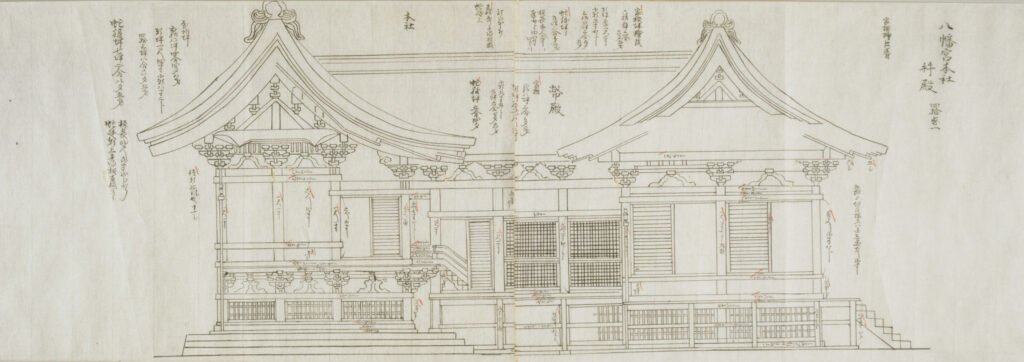
The current main sanctuary of Tsurugaoka Hachimangu was reconstructed in 1828 (Bunsei 11) and exemplifies traditional Japanese architectural blueprints at their finest. It features a distinctive “yatsumune-zukuri” (eight-ridged) roof style, combining a central irimoya-zukuri (hip-and-gable) structure flanked by nagare-zukuri (flowing style) structures on both sides. This “sanja-zukuri” (three-shrine style) configuration directly reflects the shrine’s dedication to three deities—an elegant harmony of form and function.
The copper-plated roof is adorned with ornamental ridge-end tiles called “shibi,” which were believed to protect the building from fire. Beneath the eaves, intricate bracket systems (tokyō) showcase the pinnacle of Japanese carpentry, seamlessly blending decorative elements with structural requirements in a way that epitomizes traditional Japanese architectural principles.
Dance Hall and Offering Hall
In front of the main sanctuary stands the mai-dono (dance hall), an octagonal structure where sacred kagura dances and other rituals are performed. Its interior features a vibrantly colored ceiling with symbolic paintings. Further forward is the heiden (offering hall), where worshippers present prayers and offerings. Together with the main sanctuary, these buildings form the “gongen-zukuri” layout—a fundamental configuration in Japanese shrine architecture.
Particularly noteworthy is the architectural expression of “depth aesthetics” demonstrated in these buildings’ arrangement. The increasing sanctity as one progresses deeper into the shrine complex architecturally manifests the traditional Japanese concept of separating the sacred from the secular—a spatial journey from the mundane to the divine.
Tsurugaoka Hachimangu: A Living Legacy
Following Yoritomo’s death, successive rulers including the Hojo regents, the Ashikaga shogunate, Toyotomi Hideyoshi, and the Tokugawa clan have reverently supported the shrine’s reconstruction and preservation. Tokugawa Ieyasu, in particular, commissioned extensive renovations to pray for his shogunate’s prosperity.
Into the modern era, Tsurugaoka Hachimangu continues to host various traditional ceremonies throughout the year, including the New Year’s visit (hatsumode)—a practice reportedly initiated by Yoritomo himself—as well as the annual festival and the spectacular yabusame (horseback archery) demonstrations. These living traditions maintain the shrine’s significance as a vibrant cultural heritage site embodying Japanese spiritual identity.
Precious Architectural Resources: Access to Traditional Japanese Architectural Blueprints
To deepen your understanding of Tsurugaoka Hachimangu’s architectural significance, we offer access to the following historical blueprints. These traditional Japanese architectural blueprints provide invaluable reference materials for architectural designers, historians, game developers, and anyone interested in traditional Japanese architecture.
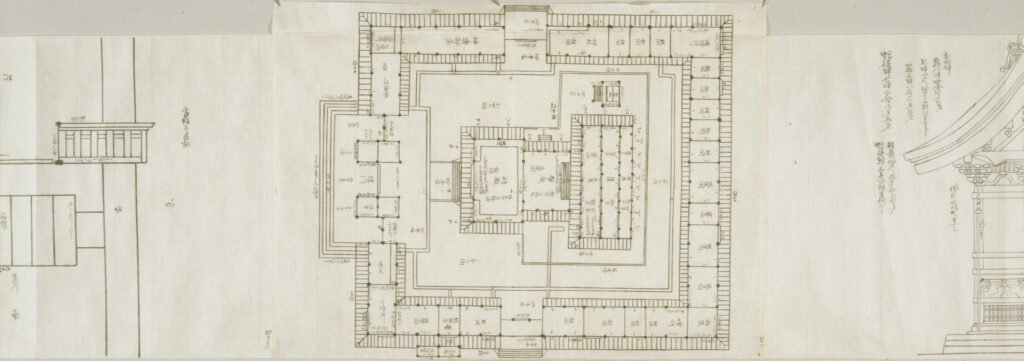
Site Plan of Tsurugaoka Hachimangu in Sagami Province
The Tokyo National Museum houses the “Soshu Tsurugaoka Hachimansha Jiwari Shizu” (Site Plan of Tsurugaoka Hachimangu in Sagami Province), an Edo-period document offering a bird’s-eye view of the entire shrine complex. This detailed blueprint records the positioning of shrine buildings, pathways, and surrounding environment, providing crucial insights into the spatial composition of traditional Japanese shrine architecture.
Illustrations of Tsurugaoka Hachimangu and Its Various Halls
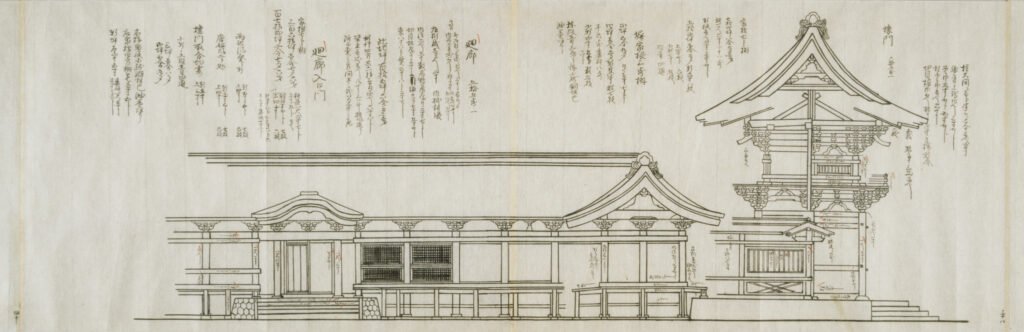
Available through the National Diet Library Digital Collection, the “Tsurugaoka Hachimansha Narabi ni Shodo Sha Ezu” (Illustrated Plan of Tsurugaoka Hachimangu and Its Various Halls) meticulously depicts not only the main sanctuary and dance hall but also the numerous subsidiary shrines scattered throughout the grounds. This comprehensive document reveals the complete picture of Tsurugaoka Hachimangu during the Edo period.
Conclusion: Preserving Traditional Japanese Architecture for Future Generations
Tsurugaoka Hachimangu transcends its role as a religious institution—it stands as a culmination of Japanese history, culture, spirituality, and architectural expertise. Through these traditional Japanese architectural blueprints, we can connect with the wisdom and aesthetic sensibilities of our predecessors.
In this digital age where historical architectural documents have become increasingly accessible, we bear the responsibility to study these valuable cultural treasures and transmit them to future generations. May the architectural beauty and historical significance of Tsurugaoka Hachimangu continue to inspire new creative expressions in Japanese culture for centuries to come.
These traditional Japanese architectural blueprints serve not merely as historical documents but as windows into the Japanese cultural psyche—revealing how space, spirituality, and social hierarchy intertwined to create environments of exceptional harmony and meaning. By studying these plans, modern practitioners can discover timeless design principles that transcend their historical context and offer valuable insights for contemporary architectural challenges.
Explore More Free Downloadable Resources
If you’re interested in discovering more freely downloadable historical Japanese art resources for your creative projects, click the banner below. Our curated collection includes additional ukiyo-e prints, kimono pattern books, and rare illustrated manuscripts that offer authentic glimpses into Japan’s artistic heritage. Continue your journey through the floating world and beyond with these carefully selected visual treasures from Japan’s golden age of woodblock printing.
