In our previous article, we introduced several collections of cute ukiyo-e sketches by renowned artists like Hokusai and Hiroshige. For this second installment, we’ll explore additional fascinating sketch collections by other talented Edo and Meiji period artists, all available through digital archives that you can access for free.
The Modern Appeal of Edo-Period “Ryakuga” Culture
In Japanese art from the Edo period (1603-1868) through early Meiji era (1868-1912), a drawing style called “ryakuga” (simplified drawing) held special significance beyond mere practice sketches or preliminary drawings. The aesthetic principles of “shouhitsu” (economy of brushwork) and “shoryaku” (simplification) represent traditional characteristics of Japanese art, but Edo-period artists particularly refined these techniques, mastering the art of capturing a subject’s essence with minimal lines.
In today’s world of graphic design and illustration, the skill of effectively expressing a subject’s characteristics through simple lines remains highly valued. Understanding that the roots of this approach lie in Edo-period ryakuga culture reveals that these works weren’t merely classical pieces but possessed a progressive quality that connects to modern visual communication.
For Western audiences, “ryakuga” might be compared to the minimalist sketching techniques that gained popularity in 20th-century design, though the Japanese tradition predates these Western movements by centuries.
Now, let’s explore more collections of cute ukiyo-e sketches available for free viewing.
Free Collections of Cute Ukiyo-e Sketches from Edo Japan
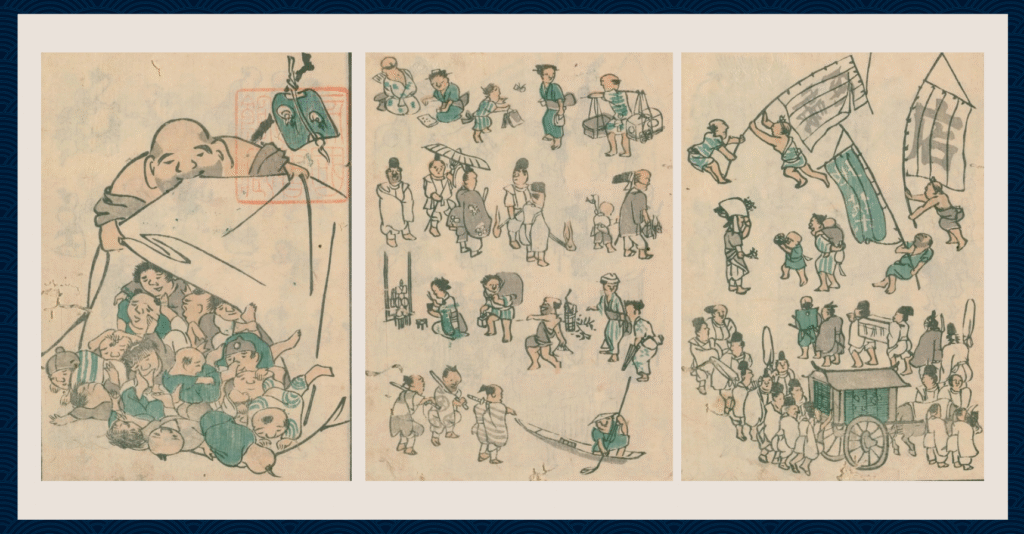
Kawamura Bumpo’s “Bumpo Soga” — A Microcosm of Commoner Life
Kawamura Bumpo (1737-1793) was an artist active during the mid-Edo period, primarily known for his bird-and-flower paintings. However, in “Bumpo Soga,” he meticulously depicts scenes from the daily lives of ordinary people. The term “soga” refers to simplified, sketch-like works.
What makes this collection particularly special is how Bumpo incorporates numerous small life scenes within a single composition. People pounding rice cakes (mochi), children swimming in rivers, individuals trying to catch sparrows, people bathing in public bathhouses—these vignettes of Edo life are depicted with remarkable vitality.
From a contemporary perspective, these miniature figure drawings exhibit a manga-like “deformation” quality that connects to our modern sense of “cuteness” or “kawaii.” Additionally, the composition style of filling a single picture with diverse scenes can be seen as a precursor to modern Japanese design aesthetics found in “yuru-chara” (mascot) merchandise and other contemporary Japanese visual products.
This 26-page collection serves as a veritable “encyclopedia of daily life” from the Edo period, offering valuable historical insights alongside its artistic merit.
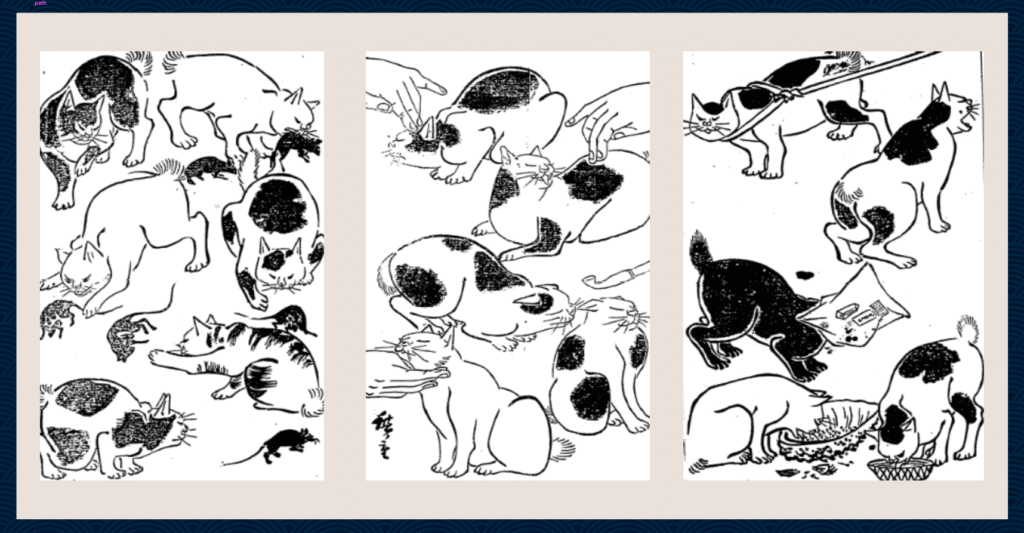
Utagawa Hiroshige III’s “Hyakkuneko Gafu” — A Must-See for Cat Lovers
Utagawa Hiroshige III (1842-1894), a disciple of the original Hiroshige, created “Hyakkuneko Gafu” (Album of One Hundred Cats), which was originally serialized in the magazine “Robun Chinpo” published by Meiji-era writer Kanagaki Robun (1829-1894). Later published as a standalone book, this work serves as a catalog of cats in various poses and situations, as its title suggests.
The relationship between Japanese people and cats dates back centuries, with cats appearing in the famous “Choju Giga” (Scrolls of Frolicking Animals) from the Heian period (794-1185). However, cats became particularly popular subjects in art during the Edo and Meiji periods. In “Hyakkuneko Gafu,” we see playful cats, sleeping cats, cats transforming into tanuki (raccoon dogs), and many other expressions and poses that might be considered precursors to modern “cat manga” and cat character designs.
Kanagaki Robun was also known as an early Meiji journalist, and in “Hyakkuneko Gafu,” he attempted a new form of expression that combined illustrations with text. This can be considered a pioneering example of media mixing that connects to modern manga and illustrated essays.
For Western readers unfamiliar with Japanese literary figures, Kanagaki Robun was one of Japan’s first modern journalists and a pioneer of gesaku literature, a form of popular fiction that often incorporated humor and social commentary.
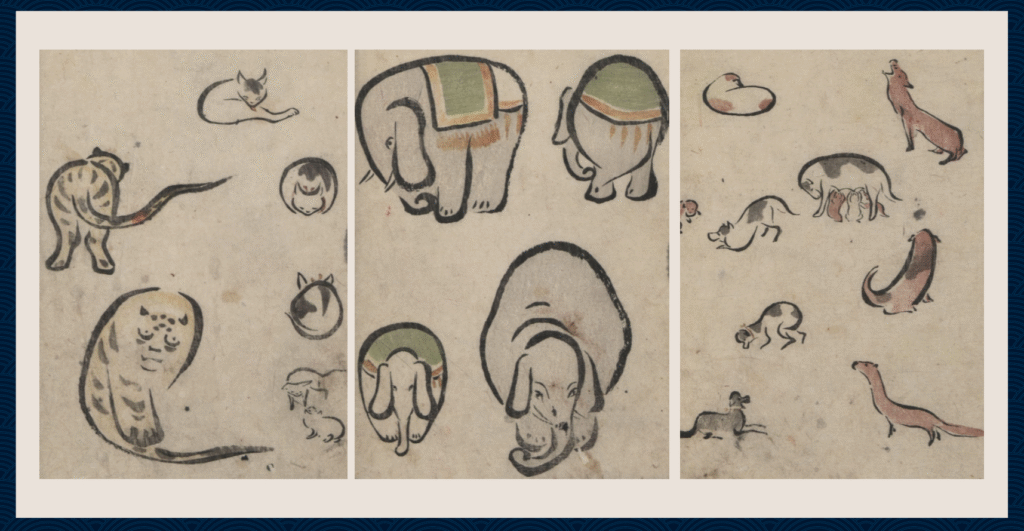
Kitao Masayoshi (Kuwagata Keisai)’s “Choju Ryakugashiki” — A Classical Animal Sketching Guide
Kitao Masayoshi (1764-1824), also known by his art name Kuwagata Keisai, was an artist active from the middle to late Edo period. His “Choju Ryakugashiki” (Simplified Drawing Method for Birds and Beasts) is a drawing manual depicting animals, marine creatures, and insects with simple lines, which greatly influenced later artists.
“Ryakugashiki” refers to a series of instructional books systematically demonstrating drawing methods, and Keisai was a pioneer in this field. His works were so highly regarded that they were imitated by later artists, including Hokusai, playing an important role in visual education during the Edo period.
In modern design education, training to “simplify motifs to capture their essence” is emphasized, and “Choju Ryakugashiki” was a pioneering educational material for this approach. Keisai’s technique of accurately expressing various creatures—birds, rabbits, dogs, cats, fish, and more—with minimal lines offers valuable lessons for contemporary illustrators and designers.
For those familiar with Western art history, Keisai’s approach might be compared to the gesture drawing techniques developed in Renaissance ateliers, though with a distinctly Japanese aesthetic sensibility.
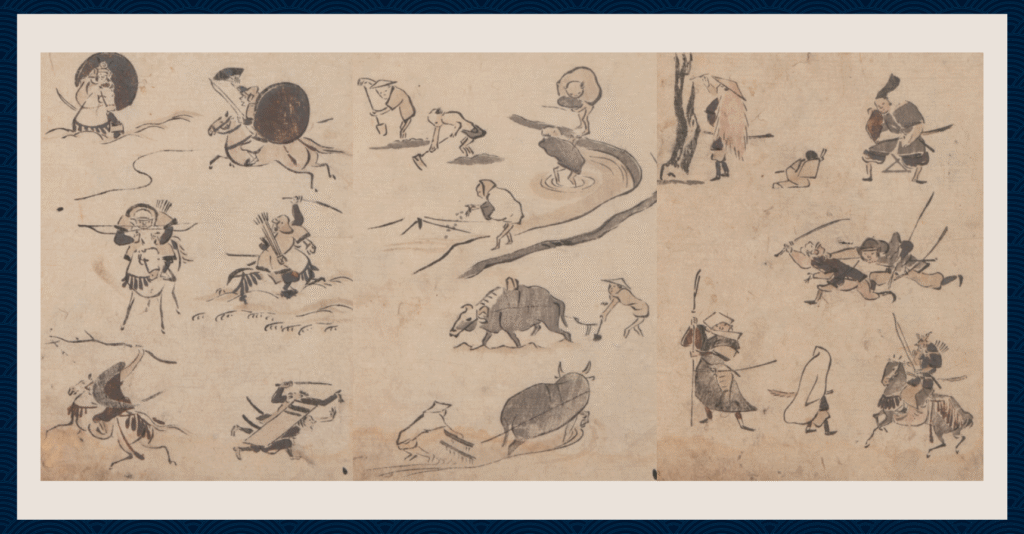
Kuwagata Keisai’s “Jinbutsu Ryakugashiki” — A Guide to Human Expression
Alongside “Choju Ryakugashiki,” another important work by Keisai is “Jinbutsu Ryakugashiki” (Simplified Drawing Method for Human Figures). This collection demonstrates various human postures, actions, and expressions using simple lines, serving as a valuable resource for understanding the gestures and mannerisms of Edo-period people.
“Jinbutsu Ryakugashiki” shows basic actions like standing, sitting, walking, running, sleeping, and dancing in simplified form, which parallels techniques used in modern animation and manga for depicting movement. Particularly, the technique of capturing the essence of human movement with minimal lines holds universal value applicable to contemporary character design.
Japan has traditionally had a culture of “kata” (forms or patterns), with specific movements systematized in practices like tea ceremony and martial arts. “Jinbutsu Ryakugashiki” can be seen as a visual art version of this tradition, representing an important attempt to organize and teach human movements as “kata.” It reflects a uniquely Japanese bodily awareness and aesthetic sensibility, holding cultural value beyond mere drawing instruction.
For Western audiences, the concept of “kata” might be familiar through martial arts, but understanding how this principle extends to visual arts offers deeper insight into Japanese cultural aesthetics.
Design Wisdom from Edo-Period Sketches
These cute ukiyo-e sketches from the Edo period hold universal value applicable to modern design and illustration. Particularly noteworthy aspects include:
Economy of Line
The essence of the “ryakuga” technique lies in achieving maximum expression with minimal lines. This approach parallels modern minimalist design and diagrammatic representation. The paradox that stripping away superfluous decoration and capturing a subject’s essence can create a stronger impression represents a timeless truth that transcends eras.
This principle of visual economy anticipates the 20th-century modernist dictum “less is more” by over a century, showing how Japanese artists had already developed sophisticated approaches to visual simplification.
Universality of Emotional Expression
Particularly in animal and human sketches, Edo artists skillfully expressed joy, anger, sorrow, and pleasure with minimal depiction. It’s not an exaggeration to say that the origins of simplified emotional expressions seen in modern emoji and stickers can be found here.
Contemporary research in cognitive psychology supports the effectiveness of simplified facial expressions for emotional communication, confirming the intuitive understanding these Edo artists demonstrated.
Systematic Visual Education
The systematic creation of instructional books like the “Ryakugashiki” series indicates how advanced visual education was during the Edo period. These works contain deep insights into the relationship between “seeing” and “drawing” that connect to modern design education.
Unlike the European atelier tradition that emphasized careful observation and reproduction of nature, the Japanese approach often privileged capturing the essential character of subjects through simplified representation.
Tracing the Roots of Japanese “Kawaii”
The aesthetic sensibility of “kawaii” (cuteness) that characterizes modern Japanese pop culture didn’t emerge suddenly but can trace its roots to this ryakuga culture of the Edo period. In particular:
- Balance between omission and emphasis: The technique of emphasizing characteristic features while omitting others, seen in modern “yuru-chara” mascots
- Emphasis on everyday life: The sensibility that finds value in familiar life scenes rather than grand themes
- Pursuit of approachability: The attitude of aiming for expressions that everyone can enjoy rather than high-brow art
These characteristics are common in Edo-period cute ukiyo-e sketches and represent aesthetic sensibilities that Japanese visual culture has continuously inherited. Art historians have noted that while Western cartoons often exaggerate for comedic effect, Japanese simplification in art frequently retains a gentle quality that evokes empathy and intimacy—key components of the kawaii aesthetic.
Conclusion: The Edo Sketch Spirit Living in Modern Times
The cute ukiyo-e sketches by the four artists introduced in this second installment each possess distinct charms: Kawamura Bumpo’s detailed depictions of daily life, Hiroshige III’s adorable cats, and Kuwagata Keisai’s systematic expressions of animals, plants, and human figures. These aren’t merely relics of the past but treasures that offer rich inspiration for modern design and illustration.
With the proliferation of digital archives, these valuable resources—once accessible only to specialists—can now be viewed by anyone for free. We encourage you to explore these collections of cute ukiyo-e sketches as sources of creative inspiration or as gateways to understanding the depth of Japanese visual culture.
The spirit established by Edo-period artists of “saying much with few lines” may be even more valuable to learn in our information-saturated modern era.
*Note: The contents of the digital archives mentioned in this article may change without notice due to policy changes at each institution. Please check each institution’s official website for the most current information.*
Explore More Free Downloadable Resources
If you’re interested in discovering more freely downloadable historical Japanese art resources for your creative projects, click the banner below. Our curated collection includes additional ukiyo-e prints, kimono pattern books, and rare illustrated manuscripts that offer authentic glimpses into Japan’s artistic heritage. Continue your journey through the floating world and beyond with these carefully selected visual treasures from Japan’s golden age of woodblock printing.
