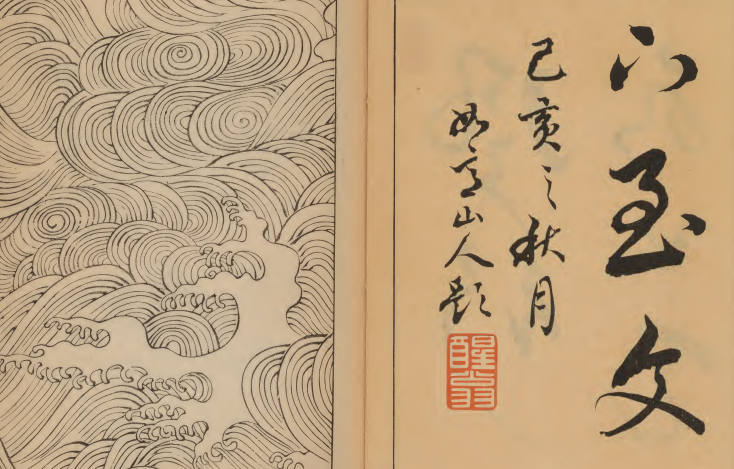
From Nordic streetwear to Silicon Valley UI kits, the hunger for Japanese traditional patterns has never been stronger. Yet most open-access databases scatter key motifs—especially waves—across hundreds of sources. Enter “Hamonshū,” a three-volume masterpiece published in 1903 by Kyoto painter Mori Yūzan. The book does one thing only—collect wave-based Japanese traditional patterns—and does it with almost obsessive completeness. Thanks to the Smithsonian Libraries and the Internet Archive, the entire set is now a free, high-resolution download that anyone may reuse commercially.
Who Was Mori Yūzan?
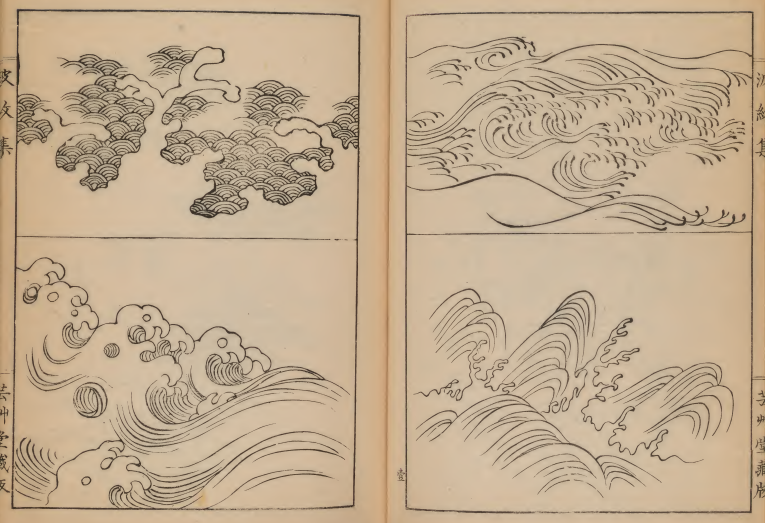
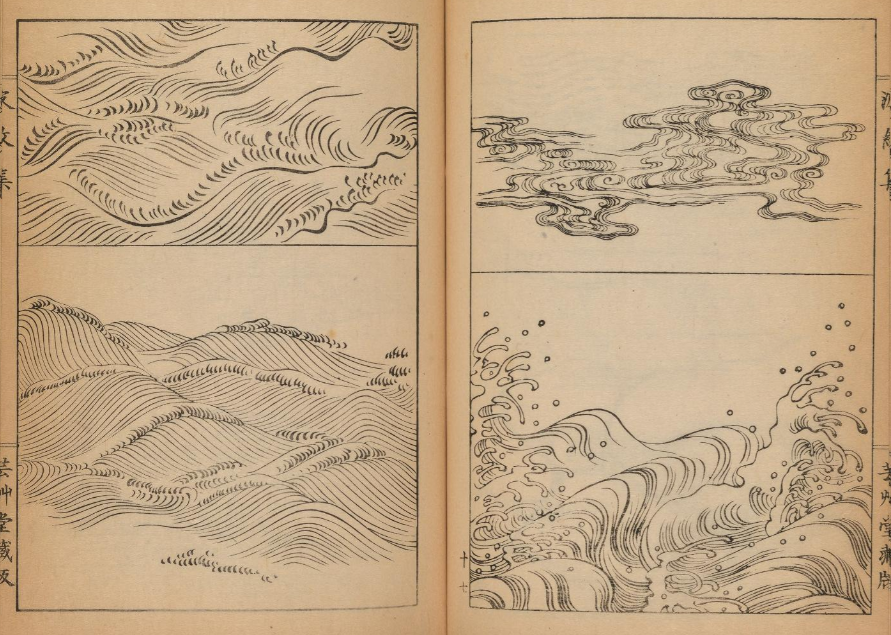
Mori Yūzan (1869–1917) was the grandson and adopted heir of Maruyama-school master Mori Kansai, sometimes called the “Ōkyo of Meiji.” Though Yūzan excelled at animal painting, he also catered to the booming export-craft market by supplying surface designs. “Hamonshū” crystallizes that career pivot: a catalog of Japanese traditional patterns focused solely on waves (hamon means ripple or wave crest). The result is a visual thesaurus of more than 300 variations—from the famous seigaiha fan-shaped repeat to abstract spirals that would feel at home in Art Nouveau wallpaper.
Anatomy of the Three Volumes
Every page layers multiple Japanese traditional patterns on one sheet, making it easy to compare thickness of line, scale of repeat, and negative-space treatment.
- Volume 1 (上巻): Classical roots
Ancient seigaiha, stylized tide lines, and auspicious rising-sun waves anchored in Heian-era - Volume 2 (中巻): Geometric experiments
Broken chevron waves, interlocking hexagon waves, and “lightning-wave” fusions that marry Japanese traditional patterns with Western geometry. - Volume 3 (下巻): Freehand invention
Massive curling surf worthy of Katsushika Hokusai, plus near-abstract ripples that foreshadow mid-century graphic design.
Cultural Context for Non-Japanese Readers
In Japanese visual culture, waves symbolize resilience and good fortune, because water continuously renews itself. You will notice frequent references to seigaiha—literally “blue-ocean waves”—a motif imported from eighth-century Persia via Silk Road textiles and later codified in Noh costumes. During the Edo period (1603–1868) these Japanese traditional patterns filtered into kimono stencils, sword fittings, and even public bathhouse tiles. By the Meiji era (1868–1912), wave motifs became a design lingua franca for export porcelain and lacquer, which explains why Mori Yūzan saw a global market for a book featuring nothing but waves.
How to Download “Hamonshū” in 30 Seconds
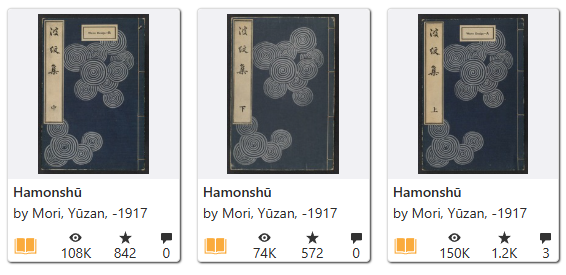
- Open the Internet Archive links (The above buttons)
- Click the gray “PDF/EPUB” button at the top; choose “PDF.”
- Save the file—each page is scanned at roughly 2,400 px on the long side, more than sufficient for print or 4K screens.
The files are labeled “Public Domain,” so you may embed these Japanese traditional patterns in commercial merchandise, or motion graphics. A polite credit might read: “Hamonshū, Smithsonian Libraries, Public Domain.”
Numbers at a Glance
- Year of publication: 1903 (Meiji 36)
- Volumes: 3
- Total motifs: 300+ distinct wave-based Japanese traditional patterns
- Average page resolution: 2,400–2,800 px
- License: Public Domain (no restrictions worldwide)
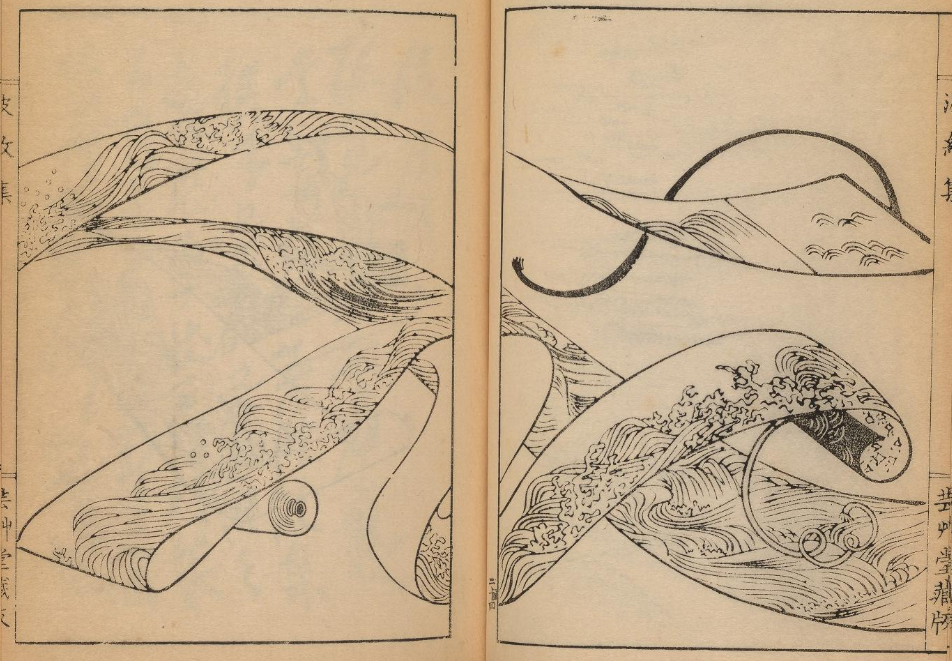
One Motif, Infinite Possibilities
“Hamonshū” proves that a single concept, when viewed through the lens of Japanese traditional patterns, can generate seemingly endless variety. Mori Yūzan’s obsession becomes our playground: 300+ wave designs, free, legal, and high-resolution, waiting to surge into your next brand identity, runway collection, or immersive VR seascape. Download the PDFs, zoom in, extract the curves, and let four centuries of Japanese ingenuity ripple through twenty-first-century creativity.
Explore More Free Downloadable Resources
If you’re interested in discovering more freely downloadable historical Japanese art resources for your creative projects, click the banner below. Our curated collection includes additional ukiyo-e prints, kimono pattern books, and rare illustrated manuscripts that offer authentic glimpses into Japan’s artistic heritage. Continue your journey through the floating world and beyond with these carefully selected visual treasures from Japan’s golden age of woodblock printing.
